


USB Power Delivery (USB PD) is an advanced charging standard enabling efficient power communication between devices, such as smartphones and laptops. It supports power transfer up to 100 watts, utilizing voltage levels from 5V to 20V. USB PD’s smart negotiation protocol dynamically adjusts power delivery based on device requirements, ensuring safety against overcurrent and overheating. This versatility enhances compatibility, streamlining the charging process with a universal connector. For a deeper understanding of its mechanisms and benefits, further insights await.
Key Takeaways
- USB Power Delivery (PD) allows for fast charging by enabling power transfer of up to 100 watts through the USB Type-C connector.
- Power negotiation between devices optimizes voltage levels from 5V to 20V for efficient charging tailored to device requirements.
- USB PD supports bi-directional charging, allowing either connected device to supply power and reducing cable clutter.
- High-quality, E-marked cables are essential for safety and performance in USB PD, preventing overheating and ensuring compatibility.
- Future trends indicate broader USB PD integration in devices, with a focus on sustainability and improved charging efficiency standards.
What Is USB Power Delivery (USB PD)?
USB Power Delivery (USB PD) is a sophisticated framework designed to enhance power management across a variety of electronic devices. First introduced in 2012, USB PD utilizes the versatile USB Type-C connector, which supports power negotiation and facilitates fast charging. This technology allows devices to dynamically negotiate power requirements, with power levels reaching up to an impressive 100 watts in earlier versions and expanding to 240 watts with USB PD 3.1. Supporting multiple voltage levels, including 5V, 9V, 12V, 15V, and 20V, USB PD can carry up to 5 amps of current. Remarkably, bi-directional charging simplifies the powering process by enabling devices to both send and receive power, thereby reducing the number of necessary chargers for users. Modern USB PD chargers often incorporate GaN technology to achieve greater efficiency while maintaining a compact form factor.
How USB Power Delivery Works
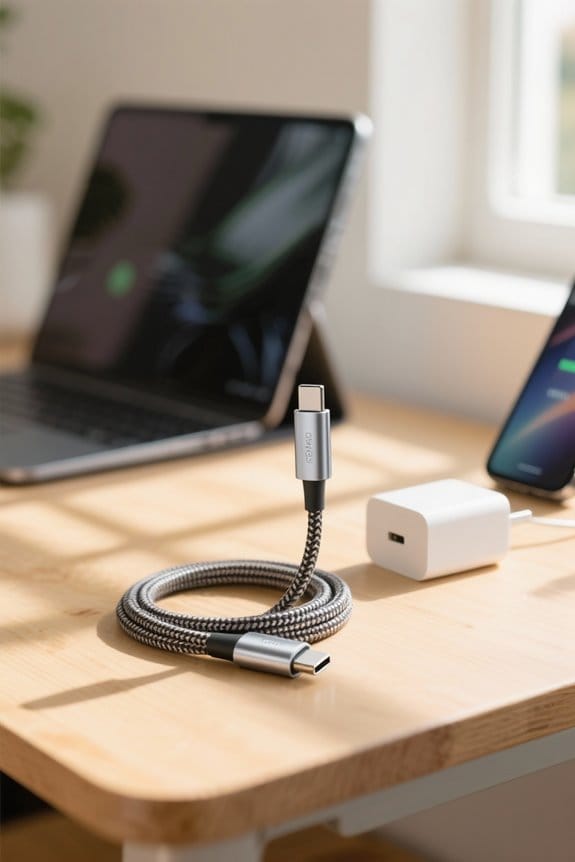
While many users benefit from the efficiency of modern charging technologies, the inner workings of USB Power Delivery (PD) are key to understanding its advantages. USB PD employs a dynamic power negotiation process, enabling devices to communicate their individual power requirements effectively. This charging process utilizes a handshake protocol that determines the ideal power level, adjusting voltage across five specified levels: 5V, 9V, 12V, 15V, and up to 20V, allowing for a maximum delivery of 100 watts. Additionally, bi-directional charging capabilities mean that a laptop can charge a power bank or vice versa. USB PD also incorporates safety features against overvoltage and overcurrent, thereby ensuring a secure charging experience across a diverse range of devices. Modern GaN technology chargers offer superior efficiency and reduced heat production compared to traditional silicon-based alternatives.
Benefits of USB Power Delivery
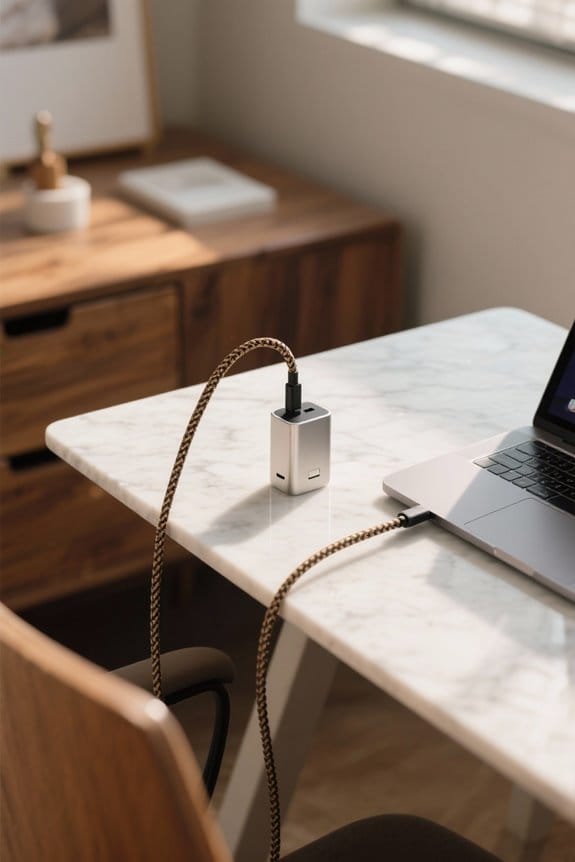
How greatly does USB Power Delivery enhance the charging experience for modern devices? With the capability to charge devices to 50% in under 30 minutes, USB Power Delivery greatly accelerates fast charging times. This universal standard simplifies the charging ecosystem, allowing one charger to fulfill the power requirements of various devices, including smartphones, tablets, and laptops. USB Power Delivery dynamically negotiates the precise power needed, optimizing efficient charging while minimizing energy waste, which is essential for battery longevity. Additionally, enhanced safety features offer protection from overvoltage and overcurrent, ensuring a secure charging experience across devices. Supporting multiple voltage levels—5V, 9V, 12V, 15V, and 20V—with up to 100 watts of power, USB PD meets the demands of power-hungry gadgets effectively. Modern Thunderbolt hubs efficiently distribute this power delivery capability across multiple connected devices, enabling simultaneous charging of various peripherals while maintaining optimal performance.
Key Features of USB Power Delivery
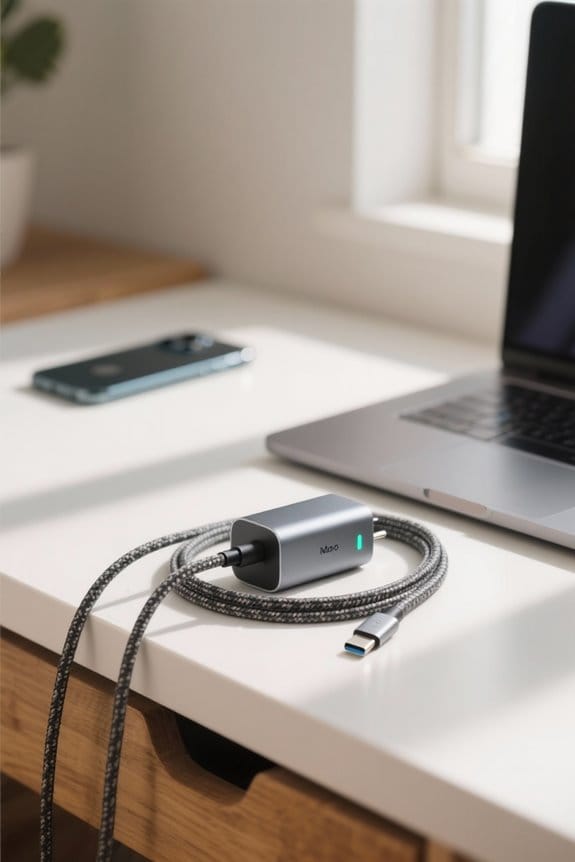
The key features of USB Power Delivery greatly elevate the charging experience across numerous device categories, making it an essential technology in modern electronics. USB Power Delivery can deliver up to 100 watts of power, accommodating various power needs and enhancing capabilities for devices like laptops and tablets. This technology employs a dynamic negotiation process, permitting devices to communicate their specific power requirements and adjust voltage levels—ranging from 5V to 20V—for ideal charging efficiency. Additionally, USB PD supports bi-directional charging, allowing power transfer in both directions as needed. Safety features, such as overvoltage protection and smart power management, enhance user confidence by preventing overheating and ensuring efficient energy transfer, ultimately providing a versatile and reliable charging solution. Modern USB-C hubs leverage these capabilities to offer fast data transfer speeds up to 10Gbps while simultaneously maintaining optimal charging performance.
USB Power Delivery Profiles
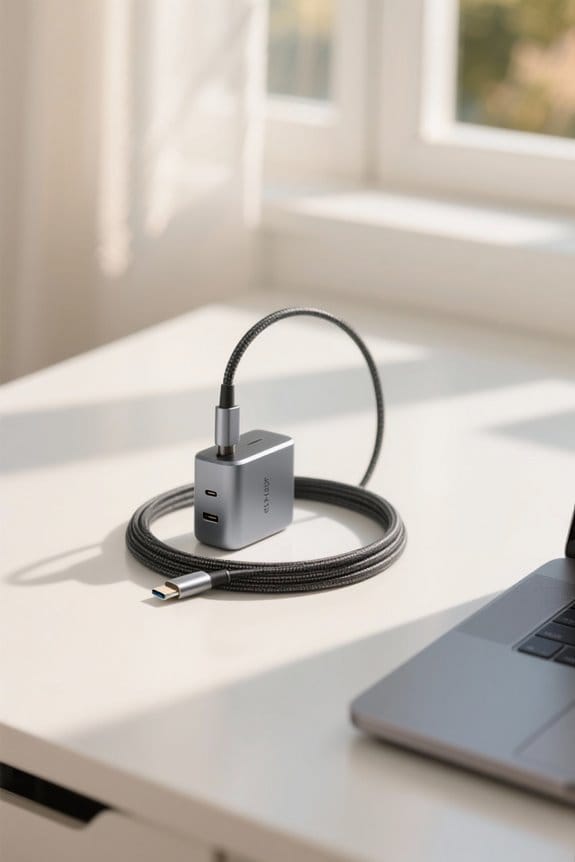
USB Power Delivery profiles serve as critical parameters that facilitate the negotiation of power levels between devices and chargers, ensuring efficient and safe charging. USB PD supports multiple power profiles, allowing devices to charge at varying power outputs, such as 5V at 2A (10W) for smartphones and 20V at 5A (100W) for laptops. These profiles offer flexibility in voltage options, including 5V, 9V, 12V, 15V, and 20V, optimizing charging efficiency based on specific power requirements. Each power profile enables devices to dynamically communicate their needs, ensuring that only the necessary power is drawn, which enhances safety during charging. Consequently, these profiles enable seamless interoperability among diverse devices and chargers, providing a universal solution across various manufacturers and product lines. Modern GaN technology chargers have revolutionized USB PD implementation by offering enhanced efficiency and smaller form factors while maintaining full compatibility with these power profiles.
Devices That Use USB Power Delivery
Increasingly, a wide range of devices are adopting USB Power Delivery technology to enhance their charging capabilities and efficiency. Smartphones, such as the iPhone 8 and newer, can charge to 50% in approximately 30 minutes when paired with compatible chargers. Laptops, particularly ultrabooks like the MacBook and Chromebook, utilize USB Power Delivery to draw up to 100 watts from USB Type-C chargers, ensuring fast charging and efficient power management. Additionally, power banks and portable chargers now support USB PD, allowing them to deliver optimized power to multiple devices simultaneously. Even emerging household appliances, including smart gadgets, are beginning to incorporate USB Power Delivery, improving their energy efficiency and enhancing user convenience. Modern USB-C adapters feature power pass-through charging capabilities that enable device charging without interrupting data transfer or video output functions.
USB Power Delivery vs. Traditional Charging
While traditional charging methods have been the standard for years, the introduction of USB Power Delivery (PD) has revolutionized how devices receive power, offering a notable contrast in efficiency and flexibility. Traditional charging typically delivers a maximum of 10W at 5V and 2A, leading to prolonged charging times. In comparison, USB PD can provide up to 100W, and even 240W with USB PD 3.1, allowing for faster charging. Utilizing dynamic power negotiation, USB PD determines the required power based on device needs. Additionally, USB PD features bi-directional charging, enabling power transfer between devices. Enhanced safety mechanisms, including overcurrent and overvoltage protection, further differentiate it from traditional charging methods, which often lack such thorough safeguards. Modern chargers like the MINIX NEO P3 exemplify these advantages with its 100W output capability and built-in protection against over-current and short circuits.
Choosing the Right USB PD Charger
Selecting the ideal charger involves careful consideration of several technical specifications to guarantee compatibility and performance. To choose the right USB PD charger, one must verify it meets the device’s power requirements; for example, a laptop typically demands at least 60W for efficient charging. Opting for certified USB PD chargers is essential, as these adhere to industry safety and performance standards, considerably reducing the risks of overheating and overcurrent situations. Portability is also important; compact designs facilitate ease of use during travel, avoiding cumbersome chargers. Additionally, high-quality USB-C cables supporting USB PD specifications are critical, as inferior options can hinder power delivery and charging speed. Confirm compatibility with specific electronics since not all chargers function universally. Look for chargers with reinforced cable materials like nylon and aluminum alloy to ensure durability through thousands of bends and daily use.
Compatibility Considerations for USB PD
When considering Compatibility Considerations for USB Power Delivery, it is vital to confirm that both the charger and the device in question support USB PD, as this compatibility allows for optimum power negotiation. Not all USB chargers are compatible with USB Power Delivery, particularly when it comes to power negotiation features. To guarantee efficient functionality, users should carefully check their connected device’s needs, as laptops may require chargers rated at 60W or higher. In addition, it is important to match the charger supports various voltage outputs, including 5V, 9V, 12V, 15V, and 20V, with the device’s input requirements. Additionally, users should avoid charge-only USB-C devices, as they do not facilitate proper power transfer or data transmission. Modern 33W charging adapters can achieve peak charging performance while maintaining device safety through built-in protection systems.
Importance of Quality Cables for USB PD
Quality cables are foundational to the efficient operation of USB Power Delivery (USB PD), as they play a significant role in managing the higher power levels required by modern electronics. Capable of delivering up to 100 watts, quality cables guarantee charging efficiency by supporting necessary voltage levels, including 5V, 9V, 12V, 15V, and 20V. E-marked cables facilitate dynamic power negotiation, allowing devices to communicate effectively. Poor quality cables, on the other hand, can lead to compatibility issues and slower charging speeds due to inadequate power handling. Additionally, high-quality cables enhance safety features, providing essential overcurrent protection and mitigating the risks of overheating or device damage. Consequently, investing in certified cables aligns with superior performance and safety standards in USB PD applications. Premium cables like those with nylon braided exteriors can withstand up to 40,000 bends while maintaining optimal charging performance.
Power Negotiation Mechanism in USB PD
Effective power management in USB Power Delivery (USB PD) is achieved through a sophisticated power negotiation mechanism that enables connected devices to communicate their power requirements during a handshake process. This mechanism facilitates ideal charging times by utilizing various voltage levels, including 5V, 9V, 12V, 15V, and 20V, ensuring that power levels are adjusted according to device needs and capabilities. Devices employ pull-up and pull-down resistors to determine their roles in the negotiation, designating which will supply or receive power. In addition, the Power Role Swap (PRS) command allows for dynamic role switching, enhancing versatility among devices. Importantly, this negotiation safeguards against overcurrent and overvoltage situations, ensuring safe power delivery throughout the charging process.
Common Misconceptions About USB PD
What misconceptions linger around USB Power Delivery (USB PD) that may lead users to misunderstand its capabilities? One common misconception is that all USB-C cables support USB PD; however, only certified cables that meet specific specifications can handle the higher power levels associated with this technology. Another misconception is that USB PD is solely for larger devices like laptops, while it efficiently supports various devices, including smartphones and tablets, by optimizing charging power. Furthermore, many users wrongly assume that USB PD chargers deliver the same power output across devices; in reality, USB PD utilizes dynamic power negotiation to provide the exact wattage needed. Additionally, not all power banks can rapidly charge, as only those adhering to USB PD standards support higher power delivery.
Safety Features of USB Power Delivery
How do USB Power Delivery (PD) safety features guarantee reliable device charging? USB PD incorporates essential safety mechanisms, such as overcurrent protection and overvoltage protection. Overcurrent protection limits the current flow, safeguarding devices from overheating and potential damage. Furthermore, compliant devices must identify their power needs, ensuring that only compatible chargers are utilized, effectively preventing damaging power surges. The PD standard requires rigorous safety certifications, allowing devices without certification to draw a maximum of only 2.5W. Enhanced overvoltage protection further shields sensitive electronics by preventing excessive voltage levels. Additionally, USB PD employs dynamic power negotiation, enabling real-time communication between devices to adjust power levels effectively, thereby minimizing risks associated with incorrect power delivery during charging scenarios.
Future Developments in USB Power Delivery
As USB Power Delivery (PD) continues to evolve in response to the increasing demand for efficient charging solutions, the upcoming USB PD 3.1 specification is poised to revolutionize the landscape of power transfer by supporting capacities of up to 240 watts. This advancement not only enhances power transfer capabilities for high-demand devices but also improves bi-directional charging, allowing devices to communicate their energy needs more effectively. Innovations in cable technology will further boost data transmission rates, greatly improving device interconnectivity. Additionally, ongoing compatibility improvements are aimed at expanding the range of devices utilizing USB Power Delivery, thereby promoting a universal charging standard across various markets. Such developments promise to transform both energy management and charging experiences in smart homes and diverse applications.
Summary of Key Takeaways on USB PD
Recognizing the significance of USB Power Delivery (PD) in modern charging solutions, it is crucial to emphasize its core functionalities and benefits. USB PD enables fast charging with power transfer capabilities of up to 100 watts, accommodating a plethora of devices ranging from smartphones to laptops. Through dynamic power negotiation, it allows devices to communicate effectively and adjust their voltage levels—5V, 9V, 12V, 15V, and 20V—as per individual power requirements. Additionally, USB PD supports bi-directional charging, enhancing versatility as devices can both send and receive power. The latest USB PD 3.1 version even boosts the maximum power delivery capacity to 240 watts. With built-in safety features, it guarantees appropriate power flow, minimizing risks of overheating and device damage.
Frequently Asked Questions
Can I Use USB PD With My Older Devices?
Older devices may face compatibility issues with USB Power Delivery due to differing power requirements and technology evolution. While charging speed may be enhanced, device limitations must be acknowledged. Various adapter options could facilitate connectivity.
How Long Does USB PD Charging Typically Take?
USB PD charging typically takes between one to three hours, influenced by charging speed, battery capacity, and charger wattage. Device compatibility and charging efficiency also play roles, while temperature impact can affect overall performance and time.
What Types of Cables Are Best for USB PD?
The best cables for USB Power Delivery boast high power ratings, appropriate cable specifications, and connector types ensuring compatibility. Charging efficiency enhances with ideal cable length, creating a synergy that maximizes performance in various charging scenarios.
Does USB PD Charge Devices Faster Than Standard USB?
USB Power Delivery charges devices faster than standard USB by leveraging advanced power delivery technology. Its fast charging benefits outshine standard USB limitations, although device compatibility issues may arise, requiring careful consideration during charging speed comparisons.
Can USB PD Provide Power to Multiple Devices Simultaneously?
USB PD can indeed power multiple devices simultaneously, like a conductor orchestrating a symphony. Power distribution and voltage negotiation maximize efficiency, while device compatibility with charging hubs and power management enhances multi-port setups for peak performance.


