


The E-Marker chip in USB-C cables is a pivotal element responsible for transmitting essential data regarding power delivery and data transfer. It is required for cables capable of handling more than 5 amps or 60 watts, ensuring optimized voltage allocation for safe charging under the USB Power Delivery protocol. This technology enhances device compatibility, enables dynamic power negotiations, and reduces overheating risks, ultimately contributing to a more reliable user experience. Further insights into E-Marker technology await exploration.
Key Takeaways
- E-Marker is a chip in USB-C cables that manages power delivery and data transmission, ensuring compatibility and safety.
- Mandatory for cables supporting over 5 amps or 60 watts, it optimizes voltage allocation under the USB PD protocol.
- The E-Marker chip communicates cable specifications like current capacity and length, preventing overload damage to devices.
- It facilitates dynamic power delivery negotiations, enhancing charging efficiency and reducing overheating risks.
- Non-compliant cables lacking E-Marker may fail to deliver adequate power, posing risks to high-demand devices.
Understanding E-Marker Technology
Understanding E-Marker technology is essential for anyone working with USB-C cables, as this sophisticated feature plays a critical role in ensuring peak performance and safety. The E-Marker chip acts as an identification system that relays crucial information regarding data transmission and power delivery capabilities. It is mandatory for USB-C cables that support 5 amps or exceed 60 watts, enabling safer charging through the USB Power Delivery (USB PD) protocol by optimizing voltage allocation. By providing data such as the cable’s length, current capacity, and vendor identifiers, the E-Marker chip enhances compatibility and prevents overload situations. Without this chip, high-demand devices may experience improper current distribution, posing risks of damage due to inadequate power delivery. Modern USB-C cables equipped with E-Marker 3.0 chip can perform real-time monitoring of current and voltage to ensure optimal charging performance.
Importance of E-Marker in USB-C Cables
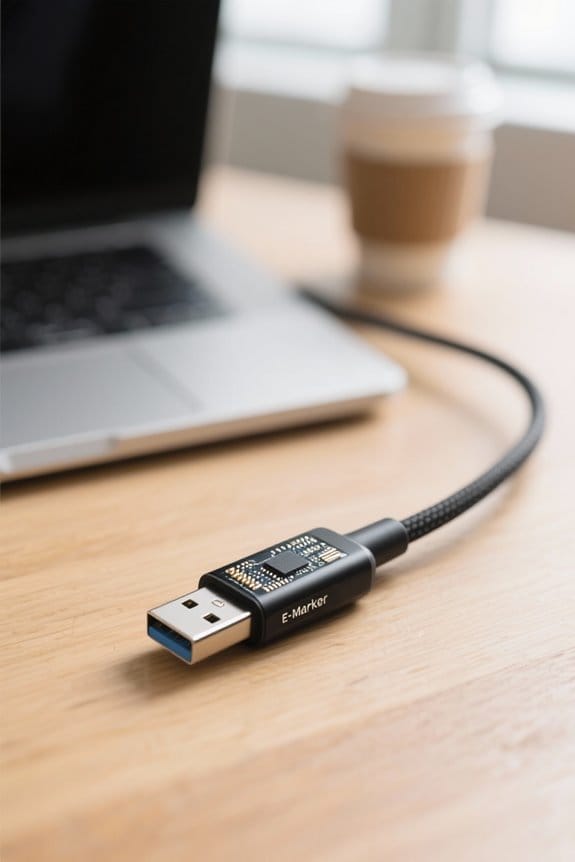
The E-Marker chip serves as a cornerstone for maximizing the functionality and safety of USB-C cables that support high power delivery specifications. This vital component guarantees the safe transmission of power exceeding 60 watts and current levels beyond 3A, preventing potential overload and damage when connected to high-demand devices. The E-Marker chip provides essential cable specifications, facilitating effective communication between devices while optimizing power requirements and data transfer speeds. Significantly, the presence of this chip is mandatory in USB 3.1 cables, enabling data rates over 480 Mbps without compromising power integrity. Moreover, the E-Marker enhances safety by allowing dynamic power delivery negotiations, thereby improving charging efficiency and reducing the risk of overheating, ultimately contributing to a reliable user experience. Modern 33W fast charging capabilities in USB-C chargers demonstrate the E-Marker’s crucial role in achieving rapid charging speeds while maintaining device protection.
How E-Marker Enhances Power Delivery
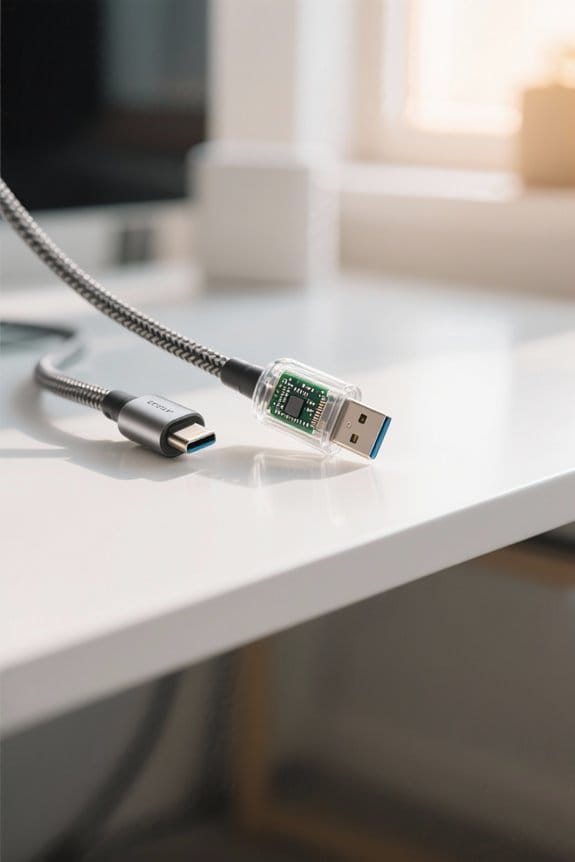
E-Marker technology considerably enhances power delivery in USB-C cables, as it facilitates a robust negotiation process that determines the appropriate power level for connected devices. This chip allows devices to safely draw up to 100W of power, adhering to the USB Power Delivery (PD) protocol. E-Marker-equipped cables communicate essential information regarding power handling capabilities, helping identify maximum voltage and amperage ratings. By ensuring that the current does not exceed safe limits, E-Marker reduces overheating risks and potential device damage. The negotiation process also improves compatibility between the power source and connected devices, promoting reliable performance. Overall, the integration of E-Marker fosters stability in power delivery, ensuring devices receive the correct power without overloading the cable. Advanced wireless chargers with smart chip technology monitor charging conditions continuously to prevent potential safety hazards during power delivery.
The Role of E-Marker in Data Transmission

In the domain of USB-C cables, the inclusion of an E-Marker chip greatly influences data transmission capabilities, particularly for higher-performance applications. While the E-Marker is essential for guaranteeing proper power delivery, it primarily serves to enhance compatibility standards, especially with USB 3.1 Gen cables. These cables can achieve data transfer rates up to 10Gbps, yet they require an E-Marker to function at peak performance. Conversely, USB 2.0 cables, which can also incorporate the E-Marker, are limited to a maximum data rate of 480Mbps, illustrating varied capabilities across USB versions. By effectively identifying cable specifications, the E-Marker allows devices to negotiate appropriate power levels and promotes safe operation, emphasizing the important role of E-Marker technology in the USB Type-C landscape. Modern USB-C chargers with PD 3.0 technology enable compatible devices to reach 50% charge in just 30 minutes, showcasing the efficiency of E-Marker enabled power delivery systems.
Risks of Non-Compliant USB-C Cables

Although many consumers may overlook the importance of compliance in USB-C cables, the risks associated with using non-compliant options can lead to serious safety concerns. Non-compliant USB-C cables, lacking an E-Marker chip, may fail to manage power delivery efficiently, potentially resulting in unsafe current outputs. For instance, devices requiring higher power levels, such as the Apple MacBook Pro 16″, which demands 96W, can be severely damaged. Cables marketed under 60W limitations often compromise safety, inadvertently allowing hazardous overheating. Additionally, incompatible models, like the Samsung Note 10+ and S20 Ultra, requiring 4A, risk reduced performance or even failure. The absence of an E-Marker critically impairs a cable’s ability to negotiate safe power transfer, jeopardizing device safety during charging. Quality chargers like Anker implement ActiveShield technology to protect against these dangers through enhanced safety features and comprehensive voltage monitoring.
E-Marker’s Impact on Device Compatibility
Device compatibility is significantly enhanced by the inclusion of an E-Marker chip within USB-C cables, which serves as a critical component for effective communication between connected devices. This chip guarantees that cables supporting Power Delivery (PD) protocol deliver appropriate power levels, thereby preventing mismatches in power requirements, which can lead to device damage. For instance, devices like laptops, requiring up to 100W, depend on E-Marker equipped cables to safely manage power delivery. The E-Marker facilitates dynamic configuration, allowing these USB-C cables to adapt as needed, whether acting as hosts or peripherals. Additionally, a well-functioning E-Marker improves safety by confirming that cable specifications align with device needs, thereby preventing overload scenarios and promoting efficient power source utilization. Modern USB-C docks like the Plugable UD-ULTCDL model demonstrate the importance of E-Marker technology by delivering precise power management up to 100W while maintaining compatibility across multiple operating systems.
Power Delivery Negotiation Process
When a USB Type-C device connects to a power source, the power delivery negotiation process initiates an essential communication handshake to assess the specific power needs and capabilities of both entities. The E-Marker chip plays a vital role, relaying cable and device information, such as maximum voltage and current ratings, ensuring safe operation during power transfer. Utilizing the USB Power Delivery (PD) protocol, this process allows the power sink to communicate its requirements to the power source, which may include requesting specific voltage levels of up to 20V. Successful negotiation not only matches the capabilities of the USB Type-C cable but also enhances data transfer speed and safety, preventing overload situations while maintaining device compatibility. Advanced charging stations like the Anker 9-in-1 station require E-Marker certified cables to achieve optimal charging speeds up to 100W.
Testing E-Marker Compliance in Cables
Testing E-Marker compliance in USB-C cables is a critical procedure that guarantees safe and efficient power transmission, particularly for devices requiring high currents of 3A or more. The USB-IF regulations necessitate that cables adhere to specific power supply and high-speed data transfer standards to guarantee reliability. Utilizing tools like the Advanced Cable Tester v2 allows manufacturers to verify E-Marker functionality, assuring proper cable integrity, current capacity, and voltage. Compliance testing not only enhances safety, reducing the risk of damage to high-wattage devices such as laptops, but also aids in quality assurance practices. By meeting E-Marker specifications, manufacturers can greatly decrease the likelihood of costly recalls while simultaneously assuring that their products meet market demands and performance expectations. Modern power banks featuring 22.5W fast charging capabilities require properly tested E-Marker cables to ensure optimal charging performance and device protection.
Selecting the Right USB-C Cable With E-Marker
E-Marker chips in USB-C cables play a pivotal role in ensuring that devices can communicate effectively regarding their power and data transfer requirements. When selecting a USB-C cable, it is essential to choose one that includes an E-Marker chip, especially if intending to support Power Delivery above 60 watts or current exceeding 3 amps. These cables facilitate ideal negotiation between connected devices, enhancing both charging speed and high-speed data transfer capabilities. Always opt for USB-C charging cables that explicitly mention USB Power Delivery compatibility to reduce the risks of overheating or potential device damage. It is also advisable to select cables from reputable brands or certified manufacturers, as this greatly improves reliability and overall safety. Modern chargers like the Anker Nano 70W can charge a MacBook Pro to 50% in just 35 minutes when paired with a compatible E-Marker cable.
Future of E-Marker in USB-C Technology
As the landscape of consumer electronics evolves, the future of E-Marker technology in USB-C cables is poised to greatly enhance the safety and reliability of high-powered applications. With the increasing adoption of USB Power Delivery protocols, the demand for precise power management and communication will necessitate advanced E-Marker integration to support higher current capacities, potentially surpassing 5 amps. Additionally, evolving E-Marker specifications are expected to improve data integrity and power efficiency, particularly in multi-device charging scenarios. Innovations may also enhance protections against overheating and overcurrent failures, effectively addressing safety concerns prevalent in lower-quality cables. As USB-C becomes universal, E-Markers will be essential in ensuring seamless communication, device compatibility, and, ultimately, consumer confidence in high-performance computing environments. Modern PD 3.0 technology enables rapid charging capabilities while maintaining strict safety standards through E-Marker implementation.
Frequently Asked Questions
What Is an E-Marker USB-C?
Guiding through the landscape of USB-C technology, an E-Marker USB-C includes a chip ensuring functionality, compatibility, and compliance with standards. Its benefits outweigh non-E-Marker options, offering enhanced safety and efficient power delivery in devices.
What Is a 5A E-Marker Charging Cable?
A 5A E-Marker charging cable is engineered for fast charging, meeting stringent cable specifications. It guarantees power delivery compatibility, minimizes durability concerns, and mitigates compatibility issues, supporting high current output for various devices, including laptops and smartphones.
How to Spot Fake Type-C Cable?
Identifying counterfeit cables involves E mark detection methods, inspecting for signs of authenticity like manufacturer branding, checking for certification, and ensuring high-quality USB C cables include safety features and proper core counts for reliability.
What Do the Symbols on USB-C Ports Mean?
The symbols on USB-C ports signify various functions, including power delivery markers, data transfer speeds, and compatibility indicators. Understanding these symbols helps users navigate type C connections and avoid issues with charging cable standards.


